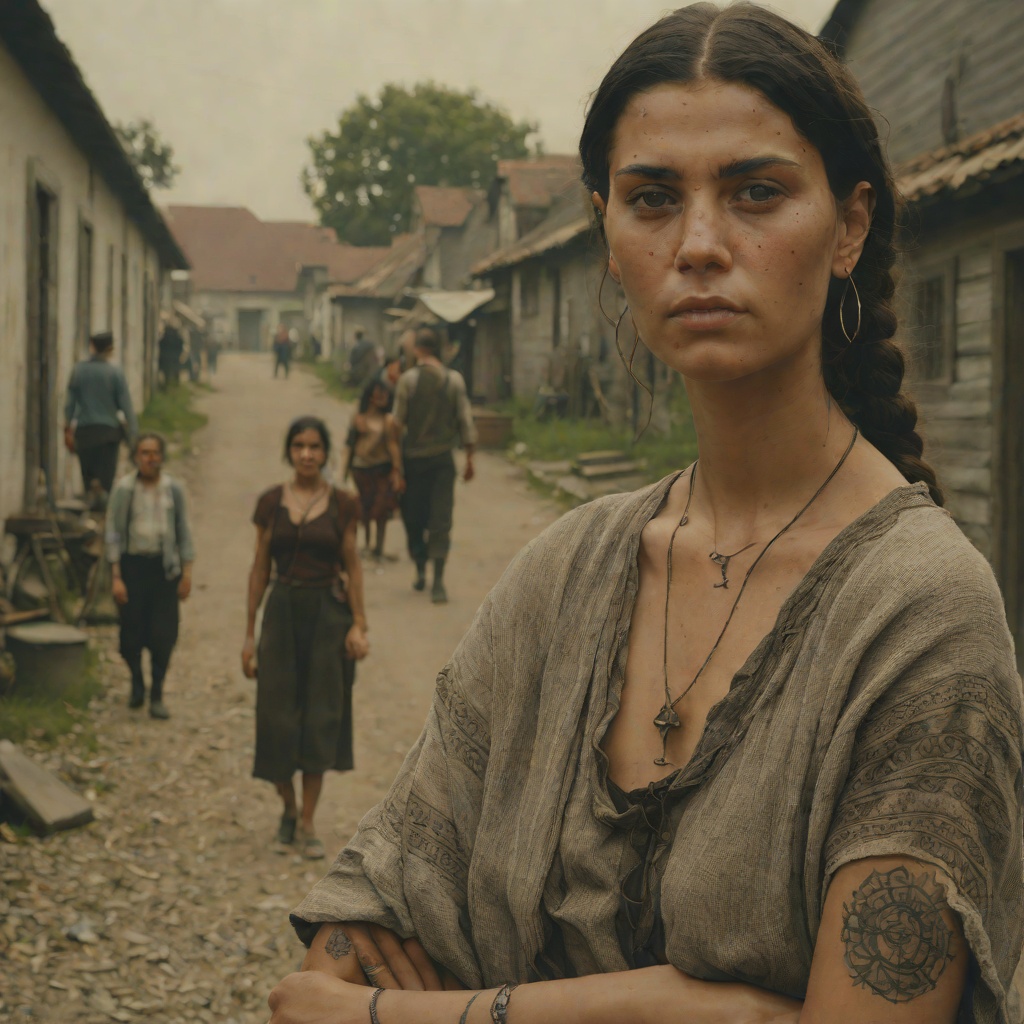
painting of a Romany woman
The Tattooist of AuschwitzThe painting of a Romany woman is a modest object that carries an outsized weight in the story of Lale Sokolov and Gita Furman. It appears at the very end of their ordeal, in the moment of their flight from Czechoslovakia, and it endures through every subsequent stage of their lives — the escape, the journey across Europe, the ocean crossing, and the new life in Australia. By the time the narrative closes, the painting still hangs in the house of their son, Gary Sokolov, a quiet survivor of the same cataclysm that the couple themselves survived. Its persistence makes it something more than a decoration: it is a witness, a talisman, and a link between the old world and the new.
The Painting in the Flight from Czechoslovakia
The painting enters the story at the moment of greatest peril and decision. After Lale Sokolov's business was nationalized and he was sentenced to two years in Ilava Prison — a place known for holding political prisoners and German prisoners after the war — the couple had been smart enough to stash some of their wealth. With contacts in the local government and judiciary, Gita Furman was able to bribe officials to help. A Catholic priest visited Lale in prison and, once alone, told him to start acting as though he were going mad; if he did a good enough job, the officials would have to get a psychiatrist to see him. Before long, Lale found himself in front of a psychiatrist who arranged for him to be given leave to go home for a few days before he "went over the edge and couldn't be brought back." A week later, he was driven to the apartment where he and Gita lived, told he would be picked up in two days to complete his sentence. That night, with the help of friends, they slipped out the back of their apartment building with a suitcase each of possessions — and the painting of a Romany woman, which Gita refused to leave behind. They also took a large amount of money to give to a contact in Vienna who was destined for Israel. Then they hid behind a false wall in a truck taking produce from Bratislava into Austria.
The painting is thus not an afterthought or a luxury item chosen in calm. It is the single object Gita insists on carrying into an uncertain and dangerous future, at a moment when every extra possession could mean the difference between escape and capture. Her refusal to abandon it speaks to its meaning for her: it is not merely art but a piece of identity, a marker of the life she and Lale had built and were now risking everything to preserve.
The Journey to Australia and the New Life
From Vienna, the couple traveled to Paris, where they rented an apartment and for several months enjoyed the cafés and bars of the city returning to its prewar self. Seeing Josephine Baker, the brilliant black American singer and dancer, perform at a cabaret was a memory Lale would always carry with him; he described her as having "legs up to here," indicating his waist. On the ship over, they befriended a couple who told them about their family in Melbourne, with whom they intended to live — enough to persuade Lale and Gita to settle in Melbourne, too. Once again, Lale entered the textile trade, buying a small warehouse and setting about sourcing fabrics locally and abroad to sell on. Gita decided she wanted to be part of the business as well and enrolled in a dress-design course, subsequently starting to design women's clothing, which added another dimension to their enterprise.
The painting traveled with them through all of this. It crossed the Atlantic or the Pacific — the narrative does not specify the route — and found a place in the new home they made on the other side of the world. Their greatest desire was to have a child, but it simply would not happen for them; eventually they gave up hope. Then, to their great surprise and delight, Gita got pregnant. Their son, Gary, was born in 1961, when Gita was thirty-six and Lale was forty-four. Their lives were full, with a child, friends, a successful business, and holidays on the Gold Coast, all supported by a love that no hardship had been able to break.
The Painting as Legacy
The painting's final appearance in the narrative is in the afterword written by Gary Sokolov, who notes that the painting of the Romany woman Gita brought with them from Slovakia still hangs in his house. This detail, placed at the very end of the book, gives the object a kind of immortality that the human characters cannot share. Lale and Gita are gone, but the painting remains, a physical link between the reader and the lived history the book recounts. It is also a link between generations: the object that Gita refused to leave behind in Bratislava now belongs to the world of her son, who was born in 1961 in a different country and a different life.
The painting thus functions as a quiet counterpoint to the dehumanizing forces that dominate the earlier parts of the narrative. Where the camp system reduced people to numbers — Lale's own number, 32407, was stabbed into his skin with a piece of wood with a needle embedded in it, then rubbed with a rag dipped in green ink — the painting is an object of irreducible particularity. It cannot be numbered or processed. It is a reminder that the world the Nazis tried to destroy was not entirely destroyed, and that some things — a painting, a love, a family — could be carried out of the ruins and into a future.
The Painting and the Couple's Character
The painting also illuminates the characters of Lale and Gita in a way that few other objects do. Gita's insistence on taking it, at a moment when they were fleeing with only a suitcase each, reveals a woman who understood the value of what could not be replaced. Lale's willingness to carry it — and to build the escape plan around it — shows the same instinct for what matters that had guided him through the camp, where he had risked his life to get penicillin for Gita and to save Mendel Bauer from the hangman by changing his number into a snake. The painting is, in this sense, the peaceful counterpart to those desperate acts: the thing worth saving when the saving is finally possible.
Its subject — a Romany woman — adds another layer. The Romani people were themselves victims of genocide, and the camp system included a Gypsy camp that was liquidated. That the painting depicts a Romany woman, and that it is the one object Gita chooses to preserve, connects the couple's personal story to a wider history of persecution and survival. It is a small, silent monument to those who were not saved, carried into the new world by two people who were.